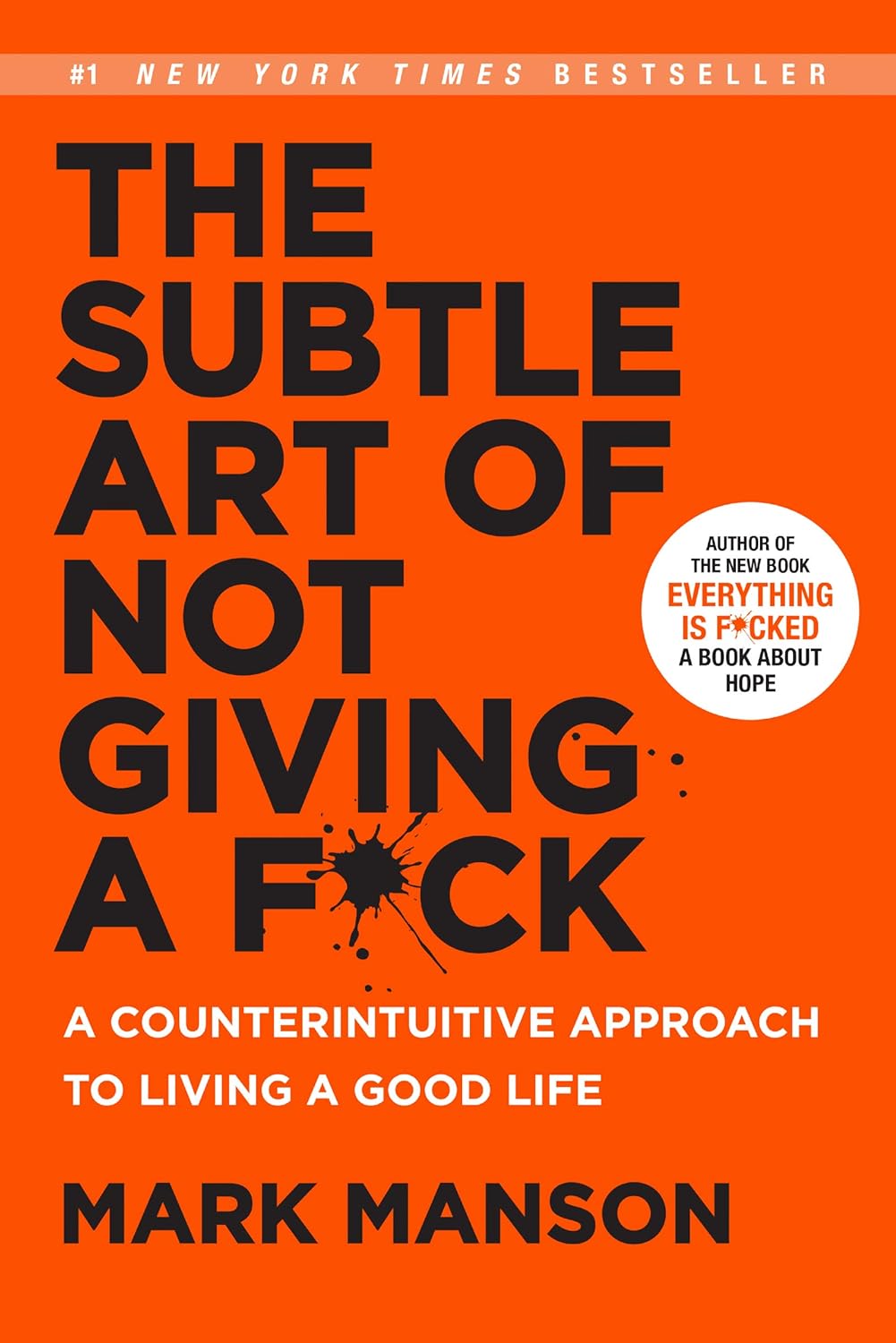
The Subtle Art of Not Giving a F*ck
Key Takeaway
You have a limited number of f*cks to give in your lifetime. The problem isn’t that you care too much, it’s that you’re spending your caring on the wrong things. Choose your battles deliberately or life will choose them for you.
The Big Picture
- Caring about everything is the same as caring about nothing, it dilutes your energy across a thousand things that don’t matter
- The path to a good life isn’t about finding more positives, it’s about choosing better problems to struggle with
- True happiness comes from solving problems you chose, not from avoiding problems entirely
Why This Book Matters For Your Day-to-Day Life
Let’s be real: the title is a marketing move. It’s designed to sit on a coffee table and make people ask questions. But underneath that provocative packaging is something surprisingly philosophical. This is Stoicism in streetwear. Marcus Aurelius in a hoodie. The ideas aren’t new, they’re ancient, but Manson delivers them in a way that lands with people who’d never pick up Meditations.
And that’s not a knock. It’s actually the book’s greatest strength.
I first read this during a period when I was drowning in comparison. I’d scroll through Instagram and see people my age hitting milestones I hadn’t touched yet. Someone closing a funding round. Someone else traveling the world while I was grinding through shifts. The metrics were eating me alive, follower counts, revenue numbers, engagement rates. I cared about all of it. And because I cared about everything, I couldn’t focus on anything.
Here’s the thing: caring about everything is just autopilot with anxiety on top. You’re not making choices. You’re reacting to every stimulus that crosses your feed. Every opinion. Every criticism. Every comparison point. Your attention is scattered across a hundred things you didn’t choose, and the things you actually care about get whatever scraps are left over.
Manson’s core argument is that you need to get intentional about what you give a f*ck about. Not care about nothing, that’s nihilism, and the book gets misread that way a lot. It’s about caring about fewer, better things. If that sounds familiar, it should. Greg McKeown’s Essentialism is the polished, corporate-friendly version of the same idea, “less but better” as a life philosophy. Manson just says it with more swearing.
The Ikigai framework gets at the same question from the opposite direction. Where Manson starts with what to stop caring about, Ikigai starts with what to start caring about, what you love, what the world needs, what you’re good at. Different cultural lenses, same destination: figure out what actually matters to you and build your life around that.
Core Concepts
The Feedback Loop From Hell
You feel anxious. Then you feel anxious about being anxious. Then you feel guilty about being anxious about being anxious. This is what Manson calls the feedback loop from hell, a spiral where your negative emotions about your negative emotions create an infinite recursion of suffering.
Social media turbocharges this loop. You see everyone else looking happy and together, so you feel bad. Then you feel bad about feeling bad because you “should” be grateful. Then you wonder what’s wrong with you. And the loop tightens.
I lived in this loop during my comparison phase. I’d feel inadequate about my progress, then beat myself up for not being more positive, then resent the people who seemed to have it figured out. The exit isn’t positive thinking. It’s accepting that sometimes you feel like garbage and that’s fine. The feeling isn’t the problem. Your resistance to the feeling is.
Choosing Your Problems
This is the concept that hit me hardest. Manson argues that happiness isn’t the absence of problems, it’s the presence of problems you enjoy solving.
Think about it.
Everyone has problems. The gym rat has sore muscles and strict diets. The entrepreneur has cash flow stress and uncertainty. The artist has rejection and self-doubt. The difference between misery and fulfillment isn’t problem-free living, it’s whether you chose your problems or they were assigned to you.
When I was in nursing, my problems were someone else’s choosing. The bureaucracy, the schedules, the emotional weight of caring for patients inside a system I didn’t design. When I started building a business, the problems got worse in some ways, less stability, more uncertainty, nobody telling me what to do next. But they were my problems. And that made all the difference.
I spend time in FIRE communities where people obsess over optimizing their way to early retirement, eliminating every problem until they can sit on a beach and do nothing. But here’s what Manson would tell them: you don’t want zero problems. You want better problems. The people who retire early and feel empty aren’t missing money. They’re missing a struggle worth having.
The Responsibility/Fault Distinction
This might be the most underrated idea in the entire book. Manson draws a hard line between fault and responsibility. They’re not the same thing. And confusing them keeps people stuck.
Fault is about the past. Responsibility is about the present.
You didn’t choose your upbringing. Not your fault. But how you respond to it now? That’s your responsibility. You didn’t cause the economic conditions that made your industry harder. Not your fault. But whether you adapt or sit there complaining? Your responsibility.
This distinction matters because people use “it’s not my fault” as a reason to do nothing. And they’re right, it isn’t their fault. But that doesn’t change the fact that they’re the only person who can do anything about it. Waiting for the person who caused your problem to come fix it is a strategy that never works.
Don Miguel Ruiz says something similar in The Four Agreements, “don’t take anything personally.” It’s the same core insight packaged differently. Other people’s actions aren’t about you. But your response to those actions is entirely about you. Ruiz wraps it in Toltec wisdom. Manson wraps it in profanity. Same destination.
You’re Wrong About Everything
This chapter is a cold shower. Manson argues that your beliefs, your values, your identity, all of it is probably at least partially wrong. And that’s not just okay, it’s necessary.
Growth requires being wrong. If you’re never wrong, you’re never learning. The people who cling hardest to their identity, “I’m a nurse,” “I’m a creative,” “I’m not a math person”, are the people who get stuck the longest. Because the moment reality contradicts their self-image, they break instead of bend.
Read that again.
This connects directly to Carol Dweck’s growth mindset from Mindset. A fixed identity is a fixed mindset wearing a costume. When you define yourself by your beliefs rather than your willingness to update them, you stop growing. Manson’s version is blunter: your identity should be a rough draft, not a final copy.
I had to learn this when I left nursing. I’d spent years building an identity around being a healthcare professional. Letting go of that, admitting that who I was didn’t have to determine who I’d become, was terrifying. But it was also the thing that made the pivot possible. You can’t walk through a new door if you’re white-knuckling the old one.
The Importance of Saying No
Every time you say yes to something, you’re saying no to something else. Manson argues that a life without rejection, without boundaries, without the willingness to say no, is a life without meaning.
This goes beyond time management. It’s about identity. You define yourself as much by what you reject as by what you accept. And if you never reject anything, if you’re the person who says yes to every invitation, every request, every opportunity, you have no shape. No definition. No identity worth defending.
I’ll admit, the edgy tone of this book can feel performative after a while. Manson knows he’s being provocative, and sometimes it reads more like branding than philosophy. But this chapter is where the tone and the message actually align. Saying no is uncomfortable. It should feel a little aggressive. Because most of us have been conditioned to be agreeable, to keep the peace, to not rock the boat. And that conditioning is exactly what’s keeping us spread too thin.
What I’ve Found Most Useful
The values audit. I sat down and honestly listed what I was giving my f*cks to, not what I said I cared about, but what my behavior actually revealed. The gap between the two was brutal. I said I valued creativity and depth. My behavior said I valued metrics and comparison. That audit alone was worth the price of the book.
The “choose your struggle” reframe. Whenever I’m feeling stuck or resentful, I ask myself: did I choose this problem? If yes, the resentment usually fades. If no, it’s a signal that something needs to change. This has become one of my most-used mental models for navigating frustration.
The feedback loop awareness. Just naming the loop, recognizing when I’m feeling bad about feeling bad, short-circuits it. Not every time. But enough. Awareness alone is about 70% of the fix.
Memorable Quotes
“Who you are is defined by what you’re willing to struggle for.”
“The desire for more positive experience is itself a negative experience. And, paradoxically, the acceptance of one’s negative experience is itself a positive experience.”
“You and everyone you know are going to be dead soon. And in the short amount of time between here and there, you have a limited amount of fucks to give. Very few, in fact. And if you go around giving a fuck about everything and everyone without conscious thought or choice, well, then you’re going to get fucked.”
Final Thoughts
I’ll be honest, this isn’t a must-read for me. The ideas are solid, but they’re covered with more depth and nuance in other books. Meditations says the same things Marcus Aurelius said 2,000 years ago, and says them more eloquently. Essentialism offers a cleaner, more actionable framework for choosing what matters. And The Four Agreements covers the “don’t take things personally” angle with more spiritual weight.
But I’ll give Manson credit for something the others don’t do as well: accessibility. This is the book you hand to your friend who won’t read philosophy but needs the message. The friend who cares about everything and is burning out. The friend who can’t stop comparing themselves to people on the internet. It meets you where you are. And sometimes that’s exactly what you need.
If you take one thing from it, take this: you’re going to care about something no matter what. That’s human. The only question is whether you’ll choose what that something is, or let the algorithm, the culture, and other people’s expectations choose for you.
Choose deliberately. That’s the whole book.

David Vo
Writing about programming your mind, finding purpose, and building wealth. Breaking free from autopilot, one system at a time.
Want more insights like this?
Join others breaking free from autopilot. One actionable insight per week on mindset, purpose, and wealth.
Subscribe for freeRelated book notes
The Defining Decade: Why Your Twenties Matter-And How to Make the Most of Them Now
Your twenties are the foundation of your life. The choices you make will determine you future.
Die With Zero
Your bank account won't follow you to the grave, but your memories will. Stop over-saving and start living.